
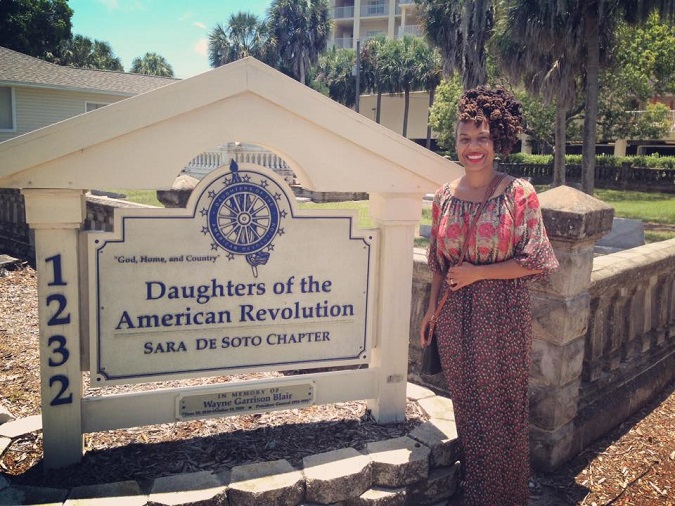
Standing in front of the Sara De Soto Chapter sign
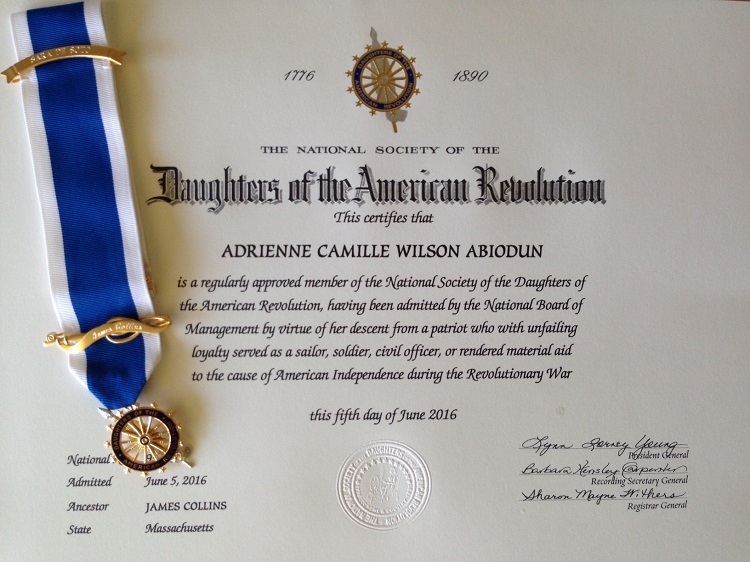
Sound the horns and throw the confetti for I am pleased to announce that I have been accepted into the Daughters of the American Revolution. For those who are unfamiliar, Daughters of the American Revolution or DAR for short is a lineage society open to any woman over the age of 18 who can prove direct lineage to a patriot who either fought or provided aid during the Revolutionary War. It is one of the oldest women’s organizations that has its core focus in three main areas: Preservation of our national history; Patriotism and love of country; Education because knowledge is key. After such a lengthy application process and exercise of the spirit of my genealogical endeavors it is such a privilege to finally be apart of this organization.
In this blog I want to share with you my reflections prior to seeking membership, my reasons for deciding to pursue membership, the application process plus how DNA assisted in my application and a word about my Revolutionary War patriot ancestor. Buckle up, because you are in for an adventure.
A Conversation Turned Pursuit
A little bit over a year ago, I was having a conversation with one of my close maternal 3rd cousins about various family lines on my maternal grandfather’s paternal side. I casually mentioned that my grandfather had at least one Revolutionary war patriot that I knew of. My cousin was surprised to hear this and asked whether I had any intention of joining the DAR. To be quite honest I had zero intentions to join prior to this conversation and none really to pursue any lineage society. On my short list of genealogical pursuits joining a society just wasn’t even on there, so naturally my cousin provided his many reasons why he felt I should strongly consider it.
So I did. I considered it. I checked out the DAR website. I read all about what the organization promoted and what it had to offer. Then I read the application requirements. Prior to reaching out to any of the local chapters for membership I decided to poll one of my Facebook genealogy groups for their feedback. Without going into too much detail about the challenges my application would face I wanted to know if they thought joining would be worth the headache. What I received was a wide range of responses. Some yes, no and maybe so. The affirmative and maybe feedback did the additional interest sparking I needed to pursue membership.
Here are some of my main reasons for deciding to join:
1. For many African American people tracing their lineage back to a Revolutionary war patriot is near impossible because of that stuff called slavery and the Civil War. The records needed just aren’t there and lineage societies need record proof. The only reason I can trace my way back to a patriot of the Revolutionary War is because my maternal grandfather’s father was white. I’ve not been able to successfully do this for any other line of my maternal or paternal family. In short, this would be my opportunity to write my family into a small slice of history that has looked over or excluded African American people for various complex reasons other than the two major road blocks listed before.
2. As a parent of two small children who I have every intention of homeschooling, a successful membership for me could easily permit them to apply and join the Children of the American Revolution (CAR). I figure this could be a nice way for them to learn more about our Nation’s history and engage in civic and patriotic activities with other children of various ages. This is in addition to any college scholarship opportunities that may be available when they are ready to pursue a college education.
3. As a stay-at-home-mom I had been looking for an organization that I could volunteer with to be an active participant in society beyond the needs of my household. Prior to having children I used to travel with Habitat for Humanity International working on Global Village projects as a team leader and team member. Life doesn’t permit me to go engage in the kind of global philanthropy I once did. Since I feel pretty at home where I live now I wanted to find something right here in my community. Little did I know beforehand that the DAR could fulfill this need too. I look forward to digging in and participating in volunteer activity this upcoming calendar year.
My Application Conundrum and Process
Now that I’ve gotten the boring stuff out the way let me tell you about the application process. As mentioned before, any woman over the age of 18 years old who can prove direct lineal descent from a patriot of the Revolution is eligible to join the DAR. The application, which can be found on the website or provided by the registrar of a local chapter requires that you walk your way back to your patriot ancestor. You start with yourself and include details such as date of birth, place of birth, marriage date, name of spouse, etc. And if the individual is deceased you include that as well. This type of information has to be listed along with record proof or sources for every generation back to the patriot. This may seem like a daunting process to go at alone, but luckily I had some amazing assistance from the registrar of my desired chapter.
Let me be the first to tell you in case you did not know: paper-trail records can be tricky and misleading things at times. For the first three generations of my application my chapter registrar noted that I would need birth, marriage and death records as source documents for each event. Beyond the first three generations a variety of sources could be used as proof as to DOB, DOD and so forth. This was all too easy for me. I already had the records. I had started collecting vital records for several direct ancestors for various reasons so I just needed to pull it from my binders. The biggest hurdle I told my registrar would be my maternal grandfather. His records were a mess and here’s why.
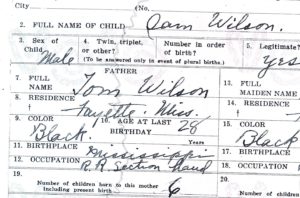
Portion of my grandfather’s birth certificate
My grandfather, Sam Allen Wilson, was born in the segregated South to a black mother and a white father. Because it was 1924 and his parents were by no means married this was information that could not and would not go on his birth certificate. Instead the midwife provided a name and race for the father that was not true. It states his father was a black man named Tom Wilson who was a RR section hand, but my grandfather’s father was actually a white man named James Moffett. While this was common knowledge and hush-hush type of talk in my grandfather’s Mississippi hometown it was a mystery to be unearthed for me.
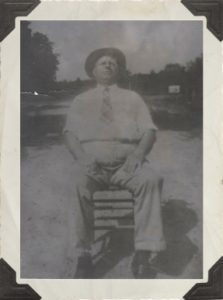
My great-grandfather, James Moffett
Long before I ever thought to join the DAR I knew there were steps that had to be taken to make fact out of fable. I had been provided several oral accounts that stated my grandfather was the child of a white man including those from his own children. My aunt had a photo of a white man seated in a chair whom my grandfather always said was his father and a birth certificate that stated his father was a black Tom Wilson. Mind you, the DAR traces lineage by using paper source records. How could I make this conflicting information sync up? The answer was DNA. Since my grandfather and his father were both deceased there would be no way to provide paternity test type of samples, so I went after the next best thing: Y-DNA. I needed to connect a male in my family with a known direct male descendant of my grandfather’s father. I decided to have my maternal uncle tested for a positive result would note that he is indeed a male descendant in close relation to James Moffett’s known descendant(s). In addition to my uncle, I made a special trip to Natchez, Mississippi to collect the DNA of my uncle’s half first cousin, a white male Moffett cousin who was in fact a known grandson of my grandfather’s alleged father. This Moffett cousin could even recall a moment during his childhood where my grandfather came to visit and stayed with his family at their home. Considering the race relations of the time this was a big deal, but to my Moffett Cousin my grandfather was just “Uncle Bubba.”
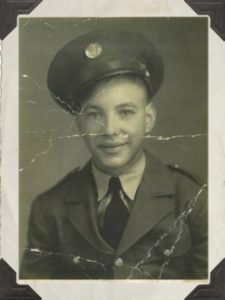
My grandfather, Sam Wilson
For the DNA testing I went with Family Tree DNA and had both participants test 67 markers of their Y-DNA. The result was near a perfect match. Out of 67 markers 66 were exact matches. My uncle had a null value on one of his markers which indicates that Family Tree DNA could not get an accurate read on that particular marker and/or my uncle may have a mutation on that marker. 66 out 67 markers and additional autosomal DNA testing definitely pegged my uncle and this Moffett cousin as half first cousins. So in my mind that’s a done deal. The DNA results combined with oral history presented a solid case of evidence to dispute the claims made by the midwife on my grandfather’s birth certificate.
Back to the DAR and how this could or would be used. Up until late 2014 the DAR did not accept DNA evidence with applications. It was paper-trail records or bust! See you – bye-bye! When they finally decided to accept DNA evidence it was outlined in such a manner I personally felt would be extremely challenging for anyone. I couldn’t imagine any applicant getting in with such use of DNA and to date there has only been one successful application under their current DNA requirements. You can read about that application here. So what about me? I’ll come back to the DNA in a moment.
My grandfather’s birth certificate wasn’t the only problem. His original death certificate was also a hot mess. I knew from his birth certificate that his date of birth was wrong, but not only that – his father was listed as Sam Wilson this time. My aunt, the one who cares nothing about genealogy and accuracy of such vital records and who I’ll cut some slack because she never knew her father’s white father, was the informant on my grandfather’s death certificate. The registrar helping me with my application noted this would also be a problem and that I should take the necessary steps to have the death record amended to reflect the correct information. Who knew you could amend a death record?! So I troubled two of my aunts with the task of having my grandfather’s death certificate amended.
After getting the amended death certificate and a few other records off my application went. I was attempting to join under my patriot ancestor Christopher Guice, my 7th great grandfather. The registrar was feeling really good about the application, but I was nervous. Not only because of my grandfather’s various record issues, but a much earlier generation didn’t appear to have as strong case for linking her to the parents whom I said she belonged. In response to my initial application the DAR sent out what is called a “Have Written” response. Although my patriot ancestor was already a proven patriot, there were some windows in my application that needed more sources. And yes, they said they would like to see the DNA evidence I had in regards to the conflicting information about my grandfather’s father. In addition to this DNA evidence I was required to gather notarized affidavits from my uncle, mother and the Moffett cousin whose DNA results would be included in a multi-page analysis done by the registrar.
Now with my grandfather’s issues out of the way for a moment I attempted to work on the other problem area which was much closer to my 7th great-grandfather, Christopher Guice, but wasn’t making any headway. I decided then to switch to a different patriot ancestor which was much easier to trace back to since he was out of Massachusetts and Massachusetts has phenomenal records sets online. Like my Guice ancestor this patriot was also already proven in the DAR database. His name is James Collins and he is my 6th great grandfather.
With the change of patriot ancestors, the DNA evidence, affidavits and analysis from my registrar I felt like we were on our way! I say we because I wouldn’t have been able to do this without her and I truly appreciate her effort on such a unique application scenario considering all her other commitments. It is important to note that the work the chapter registrars do is all unpaid.
The end result? Well I already spilled the beans so you know I made it in, but what about the final remarks from DAR HQ? Well my chapter registrar stated the application did create quite a buzz. It required a lot of additional review. Since I couldn’t test my grandfather or his father it would still be difficult for them to say that the DNA evidence I provided could 100% connect the two as father and son. I can certainly understand that knowing how Y-DNA works. The affidavits and written statement from my Moffett cousin made a stronger case for the DNA evidence I presented. My application would not have been strong enough if I had only had one, but not the other.
After everything I had to do to prove my lineage to my patriot ancestors I have to say I quite enjoyed the application exercise.
My Patriot Ancestor
I am still in the process of learning all there is to know about my patriot ancestor / 6th great-grandfather, James Collins, of Gloucester, Massachusetts. What I do know as of now is that he was kind of exceptional. First he served as an officer in Colonel Moses Little’s regiment in 1775 and later he was commissioned as commander for the “Cumberland” (privateer) in 1777. He was said to have been lost at sea and there is this pretty awesome information found online about my patriot ancestor during his time on the Cumberland.
I am very much looking forward to visiting Gloucester, Massachusetts with this new information on my patriot ancestor in tow. I hope it is a trip that will be just as exciting for my children as this whole journey has been for me.
Acknowledgements
I would like to take a moment to formally acknowledge a few people who have inspired and helped me along the way. First, my cousin Herman Jones for helping me realize that it was very much worth my time to pursue DAR membership. To all the folks that commented on my query in the Our Black Ancestry Facebook group, namely Shannon Christmas and Shelley Murphy. Your insight meant a lot. To my mother, aunts, uncles and Moffett cousin who I had to request much from (including saliva) to make this a reality. And to the very amazing chapter registrar and ladies at the Sara De Soto DAR chapter here in Sarasota, Florida. Thank you for your time and patience. It means more than you know. And for my two little ones who don’t understand all mommy’s genealogy babble now, but will hopefully appreciate all my efforts in time. Thank you!
Pingback: One Woman’s Quest to Join the DAR | Our Hidden Roots
Pingback: DAR Journey: Another’s Story | Bluebonnet Chronicles